









![Coach’s Corner: Konopasek on Iron volleyball’s 34-6 run, what’s next [video]](https://nchsinkspot.com/wp-content/uploads/2025/11/Vball-season-recap.00_00_02_22.Still005.png)


![Postgame: Volleyball falls to Marist in supersectional [video]](https://nchsinkspot.com/wp-content/uploads/2025/11/Vball-postgame.png)


![Halloween candy cross section quiz [quiz]](https://nchsinkspot.com/wp-content/uploads/2022/10/Candy-cover-big-900x675.png)
![Average Jonah? [quiz]](https://nchsinkspot.com/wp-content/uploads/2022/05/average-jonah-900x600.png)



![[Photo Illustration]](https://nchsinkspot.com/wp-content/uploads/2025/09/trigger-words-1.png)


![On the Spot: Students, staff share their takes on groundbreaking music [video]](https://nchsinkspot.com/wp-content/uploads/2026/02/Untitled-7-1.png)

![The Up-Beat – Snow, stage sets and an Illinois upset [video]](https://nchsinkspot.com/wp-content/uploads/2026/01/Untitled-10.png)
![Coaches’ Corner: Witzig, Feeney break down team identity, key growth, the road to March [video]](https://nchsinkspot.com/wp-content/uploads/2026/01/Coaches-Corner-Jan-21-1200x675.jpg)
![On the spot: Community’s favorite movies [video]](https://nchsinkspot.com/wp-content/uploads/2026/01/On-the-Spot-7.png)



![On the Spot: Staff, students sound off on the Chicago Bears’ playoff run [video]](https://nchsinkspot.com/wp-content/uploads/2026/01/On-the-Spot-4.png)
![Hauntcert performers on why this year’s show hits all the right notes [video]](https://nchsinkspot.com/wp-content/uploads/2025/10/Untitled-2.png)


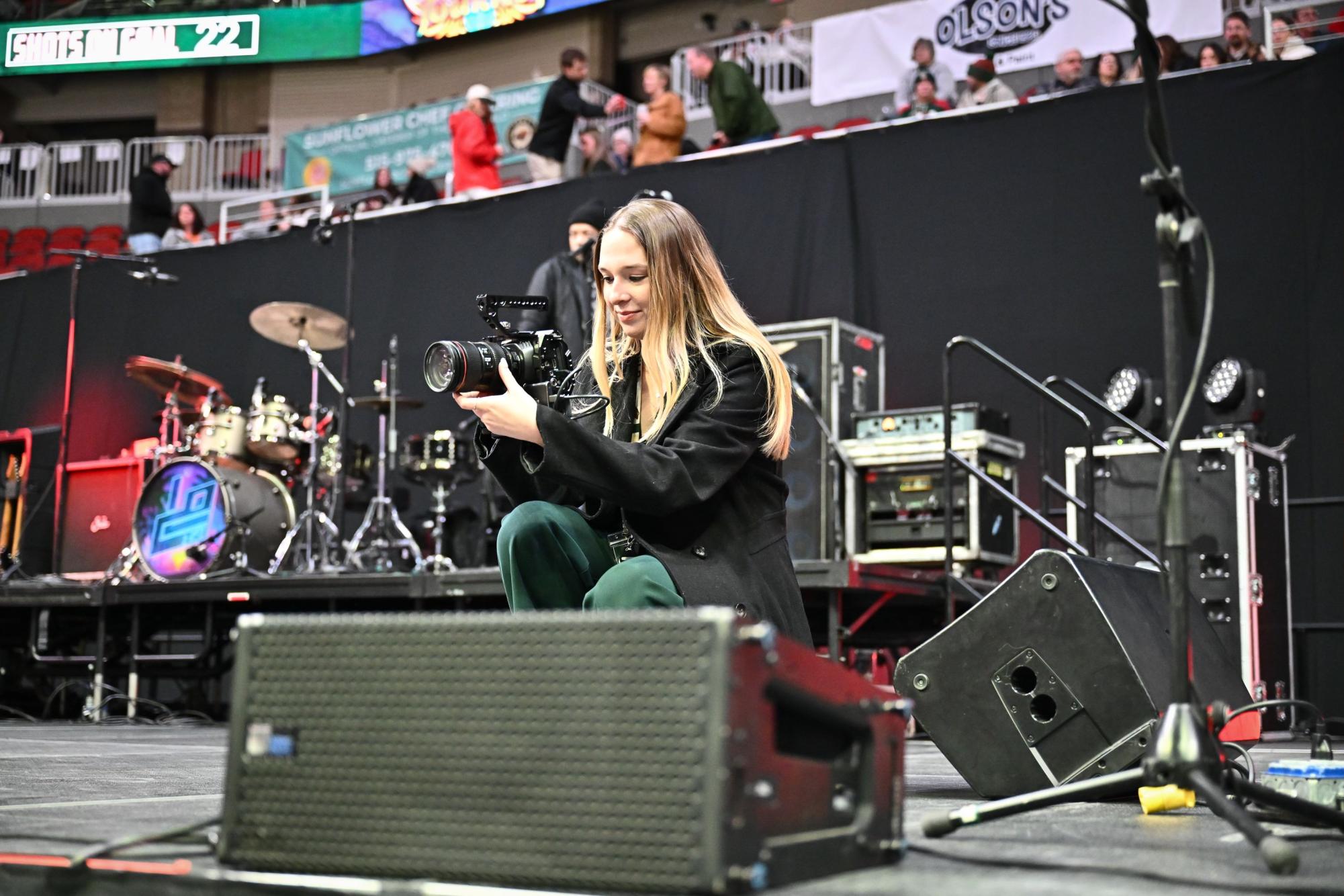
Photo Courtesy of: Abby Kimball
When the Blackhawks missed the NHL playoffs again this spring, most Illinois hockey fans called it a season.
But for Abby Kimball, a Community graduate and videographer for the Iowa Wild—the AHL affiliate of the Minnesota Wild, whose playoff run is underway—kept right on working.
In this Q&A, Kimball sat down to talk about her path from Inkspot staff member to professional hockey videographer, what it’s like to be a woman in a male-dominated sport and why she’ll always answer her phone for a gender reveal.
This interview has been edited for clarity and length.
Q: Break it down—what exactly do you do for the Iowa Wild?
A: I’m the team videographer. The Iowa Wild are the American Hockey League affiliate of the Minnesota Wild, so we’re kind of like the understudies in theater terms.
I don’t know if the guys would love that comparison, but yeah—we’re the farm team.
Q: Hockey, journalism or photography—what came first?
A: Probably journalism, actually. My dad had a friend who worked for the Blackhawks when I was growing up, so we went to a few games.
My mom always had a nice camera she used to photograph my brother and me at our sports. My brother was more competitive, so once he was older, I was the one taking photos of him.
I’m not sure exactly when I realized I could pursue something with it, but that’s probably where the seed got planted.
Q: You told your college journalism program you would do “anything but sports.” Now you’re a sports videographer. What happened?
A: It’s definitely weird to think about. I knew I wanted to do journalism going into college, but I wasn’t sure where I wanted to take it. And then obviously, here I am. Keep your options open—that’s the lesson. It’s really cool getting to be in this environment and get to be creative with it.
Q: How much did high school journalism shape where you ended up?
A: I’m honestly not sure what I would have done without it. Taking journalism opened doors and made me realize what I was capable of. I always liked to write—that was the original draw.
Also, I’m not a math person, so anything that got me out of more math classes was a win. I’d heard good things about Mr. Bovenkerk, so I figured I’d give it a shot. I actually had never had him as a teacher before, but yeah—I liked it.
Q: What’s your favorite part of shooting AHL hockey?
A: Getting to be behind the scenes and see a side of it that most people never get to. At the NHL level, I’ve heard you don’t have the same access to players that we do here. It makes sense—higher stakes.
But at the AHL level, it’s still totally professional, just a little more flexible. We’ve had the guys do a gingerbread house competition. Things like that. And we have a really good team personality-wise—guys who are actually willing to do stuff, which makes a massive difference. Just getting to see the players for who they are off the ice is special.
Q: Have you photographed anyone who went on to do something notable?
A: We’ve had two guys go to the Olympics. David Spacek played for Czechia and Samuel Hlavaj was the goalie for Slovakia—they finished fourth.
I asked them if they were excited and they both just said, “Yeah, I’m pumped,” in the most monotone voice possible. You’d think they were being dragged by their feet.
Classic hockey player answer.
We’ve also had guys go up and down to the NHL.
Ben Jones has been up and down a lot. Hunter Haight and Carson Lambos both made their NHL debuts, which is pretty cool to be there for.
And because we play Rockford—the Blackhawks’ affiliate—a lot, I’ve gotten to see guys like Kevin Korczynski and Ryan Green before they made it to the NHL. Names I heard on Chicago sports radio. Seeing them at the ice level first is a cool full-circle thing.
Q: What’s the greatest thing you’ve gotten to capture?
A: Overtime wins are always special—you get the celebration on the ice, all the guys piling on. That’s not something you always get to capture.
The teddy bear toss is something cool and different. And AHL debuts—just capturing that moment when a guy finally gets called up. Those are the ones that stick with you.
Q: What’s your dynamic like with the players?
A: It’s a weird one to explain. They’re not my co-workers, but they’re kind of my co-workers. Seeing some of them make their NHL debuts, I feel like a proud cousin.
You’ve seen how hard they’ve worked, you’ve watched them develop—and then they get there.
It’s not a personal friendship exactly, but it’s more than surface level. Following each other on social media, them knowing my name. One of our guys actually asked us to help him do a gender reveal for him and his wife. Stuff like that—being included in those moments—is really cool.
Q: What’s the craziest thing that’s happened on the job?
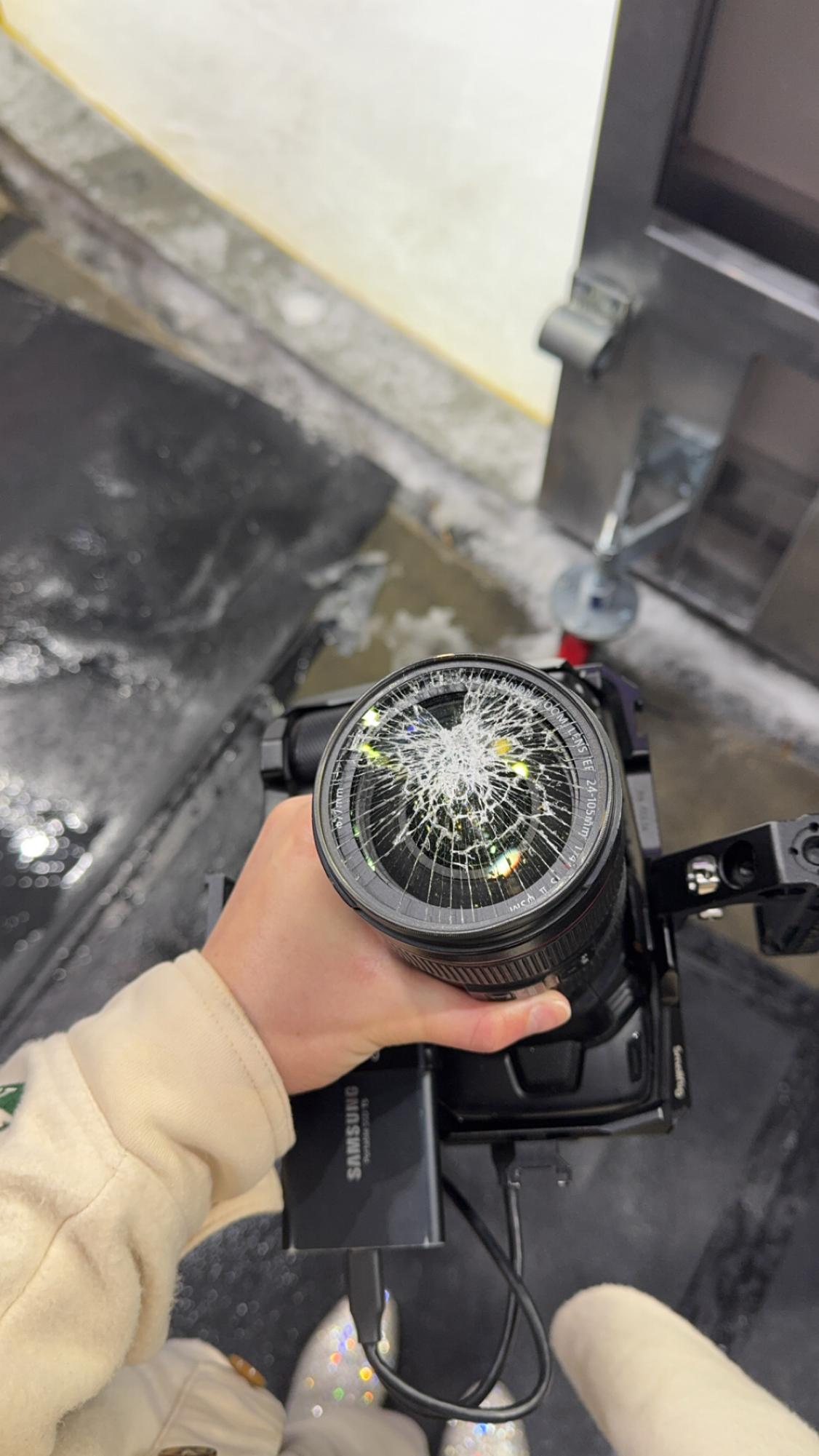
A: There are two answers to that. Shooting-wise, probably the first time I used one of the holes in the glass. One of our guys pulled off this wild trick shot and it broke my lens—well, shattered the filter over it. The lens itself survived. Best case scenario, except it was a company camera, so I felt awful.
Off the ice, we had a Dollar Dog Night promo—a dollar hotdog ticket package. Earlier that day, the guys had hot dogs for lunch and one of them tucked one away for the shoot. Somebody suggested kicking it like a field goal. I’m the videographer, so I’m standing straight on in the line of fire. They kicked it. It exploded everywhere and got all over my jacket. Definitely a “this is not in the job description” moment.
Q: What’s the goal from here?
A: I’d love to make it to the NHL. I know I won’t want to stay in sports forever—the schedule is incredibly demanding—but I’m at a point in my life where I can do it and I want to do it.
I like that hockey is indoors and protected by the glass. I’ve seen people on football sidelines just get absolutely wrecked. And baseball’s a little too slow for me.
As for the team—Chicago would be the full-circle dream. But I’ve worked a little with the Minnesota video team and they’re great.
The Blues would probably be the hardest place to go as a Blackhawks fan, but you don’t turn down opportunities.
Q: Being a woman in a male-dominated sport—how does that factor into your work?
A: There’s always an extra level of caution, because the stigma exists.
Even in college [at Mizzou], shooting D3 club hockey, people would ask, “Which one’s your boyfriend?” or “Who do you have a crush on?”
That assumption is always in the back of your head, and it makes you hold back a little—not because you’re afraid of what the players think, but because of how other people perceive it. I’m constantly aware that I have to prove I’m in this industry for the same reason anyone else is: because I want to be, I choose to be, and I love the work.
Q: What advice would you give to a high school journalist right now?
A: Keep your options open. I was completely set on writing and completely set against sports. And here I am. It’s so fun—I can’t imagine doing anything else. So whatever you think you want right now, leave room to be surprised.