


















![Coach’s Corner: Konopasek on Iron volleyball’s 34-6 run, what’s next [video]](https://nchsinkspot.com/wp-content/uploads/2025/11/Vball-season-recap.00_00_02_22.Still005.png)


![Postgame: Volleyball falls to Marist in supersectional [video]](https://nchsinkspot.com/wp-content/uploads/2025/11/Vball-postgame.png)



![Halloween candy cross section quiz [quiz]](https://nchsinkspot.com/wp-content/uploads/2022/10/Candy-cover-big-900x675.png)
![Average Jonah? [quiz]](https://nchsinkspot.com/wp-content/uploads/2022/05/average-jonah-900x600.png)




![[Photo Illustration]](https://nchsinkspot.com/wp-content/uploads/2025/09/trigger-words-1.png)


![On the Spot: Students, staff share their takes on groundbreaking music [video]](https://nchsinkspot.com/wp-content/uploads/2026/02/Untitled-7-1.png)

![The Up-Beat – Snow, stage sets and an Illinois upset [video]](https://nchsinkspot.com/wp-content/uploads/2026/01/Untitled-10.png)
![Coaches’ Corner: Witzig, Feeney break down team identity, key growth, the road to March [video]](https://nchsinkspot.com/wp-content/uploads/2026/01/Coaches-Corner-Jan-21-1200x675.jpg)
![On the spot: Community’s favorite movies [video]](https://nchsinkspot.com/wp-content/uploads/2026/01/On-the-Spot-7.png)



![On the Spot: Staff, students sound off on the Chicago Bears’ playoff run [video]](https://nchsinkspot.com/wp-content/uploads/2026/01/On-the-Spot-4.png)
![Hauntcert performers on why this year’s show hits all the right notes [video]](https://nchsinkspot.com/wp-content/uploads/2025/10/Untitled-2.png)

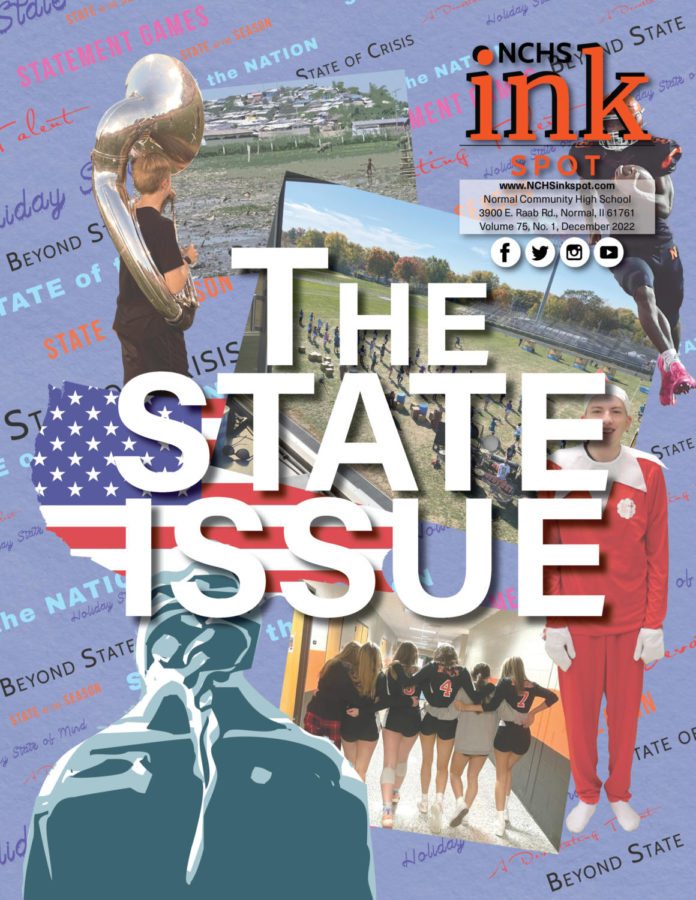






The public vs. private debate is as old as high school athletics itself.
And for good reason—take a look at the numbers and private schools appear to have an outsized edge in the IHSA playoffs.
Over the last four seasons, 22 of 32 IHSA football state champions have been private schools. While private schools make up roughly 14% of IHSA members, they’ve won nearly 70% of those titles.
Programs like Mount Carmel, Loyola Academy, and Joliet Catholic feel like annual fixtures at Hancock Stadium. The same private school names, competing for another IHSA State trophy year after year. It feels automatic.
The public vs. private argument persists because it’s a debate aimed at the wrong target.
The real divider, when it comes to postseason success, isn’t public or private. It’s infrastructure: coaching depth, offseason development, facilities and stability—all of which require resources.

Some public schools operate with private-school advantages. Some private schools don’t.
A program’s edge comes from how wide it can cast its net, its tradition and the institutional supports behind it—but, most importantly, from the financial capacity to pay assistant coaches, fund offseason training and build or renovate facilities.
The IHSA’s current tools—the multiplier and success factor—treat competitive balance as something you can measure in enrollment counts and postseason results. They do not measure what creates those results in the first place.
That’s why splitting public and private schools won’t solve the problem. It leaves the underlying imbalance untouched.
This is not a morality play. If a private school can recruit from a larger geographic area than a neighborhood public school, it would be irrational not to. If a wealthy public district can fund multiple paid assistants and year-round development, it would be silly not to use that advantage. The issue is structural: schools compete in the same class without competing under the same financial circumstances.
Start with the gap among public schools alone. New Trier, a school in one of the wealthiest communities in the Midwest, can compete in the same class as Community based on enrollment. In reality, New Trier benefits from a tax base that can support elite facilities and deeper coaching staffs.
Community is not a poor school, but it was not long ago that a referendum threatened extracurricular funding altogether. These schools operate in different financial environments, even when enrollment places them side by side.
Then there’s the private-school tier. Take Mount Carmel, which just won its fourth straight football state championship and 17th overall. The school has reported a $15 million endowment with projections to reach $50 million in the next decade. That kind of funding changes what a school, and its athletic programs, can develop and sustain.
Facilities matter, but the biggest advantage is often coaching: hiring top assistants, retaining staff and building long-term stability.
If this sounds like an abstract finance argument, it isn’t. The impact is visible.
This fall, Community’s volleyball team made an Elite Eight run before losing to eventual state champion Marist.
While Community was one of six public schools to appear in the 4A Elite Eight bracket, the title match featured two private schools.
Among those public schools? New Trier with its $75 million field house; Libertyville with its field house; Lockport with its wellness center; and Oak Park-River Forrest, a school in the midst of a multi-phase facilities renovation.

Community’s boys soccer team, too, reached the Elite Eight before losing to Naperville North, another eventual state champion.
Facing Naperville North, a public school, wasn’t exactly a level playing field for the Ironmen: the Huskies unveiled a $4.25 million storm-resistant, state-of-the-art turf field in November 2025 that gives their programs more consistent field conditions. The Huskies also boast a staff of four strength and conditioning coaches who oversee sport-specific testing, build training plans, advise athletes on nutrition and run injury-prevention programs.
Resource gaps like these make Community’s postseason runs more impressive because the climb is steeper for programs working with less—especially against opponents that can train and host on surfaces designed to stay playable year-round.
Still, a fair counterpoint deserves airtime: money does not guarantee championships.
Culture, buy-in and player development still matter. Some wealthy programs underachieve. Some low-resource programs overperform. But that does not make resources irrelevant.
It makes them a multiplier—the kind of multiplier the IHSA does not currently measure. Money buys repetitions, staff, stability and access. Over time, those advantages compound.
That is why the current framing fails.
Public vs. private treats identity as destiny. It assumes private schools win because they are private and public schools lose because they are public.
Reality is messier. Plenty of public programs have the advantages people associate with private schools. Plenty of private schools do not have state-of-the-art facilities or deep staffs. When the debate fixates on labels, the actual cause hides in plain sight.
Supporters of the current system argue the multiplier is the best available tool for competitive balance. To a point, it has narrowed the gap. Without it, private schools—especially those in the Chicago Catholic League—would likely account for an even higher share of state titles.
But it treats every private school the same and ignores public schools with major financial advantages. It’s a one-size solution for a problem that is not one-size.
Separating public and private schools is not the answer. Logistically, it would shrink playoff fields and increase travel costs. And the schools with the most resources—public and private—would still function as the same Goliaths. The resource problem would remain.
If the IHSA wants classification to reflect competitive strength, it must measure more than a headcount. A realistic step forward is adapting the current multiplier into a competitive balance multiplier.
Here is what that could look like in practice:
The IHSA keeps enrollment as the foundation, then applies a competitive balance score based on advantages that actually change outcomes. The categories should be limited, measurable and transparent. For example:
-
Coaching depth: number of paid assistants and total stipend spending.
-
Sustained high-level success across multiple sports: repeated deep postseason runs over a set window.
-
Documented transfer patterns: a clear, verified pattern of incoming transfers tied to athletics.
-
Facilities/access indicators: year-round strength and training resources available to athletes.
Schools that score above a set threshold move up one class. Schools far above move up two. Schools below stay put.
Guardrails matter. A system like this must protect schools from being punished for one great team or one special senior class. It should use multi-year windows, clear definitions and an appeals process. It should be administered by a panel with representation from public and private schools, downstate, suburban, and Chicago. And it should publish the criteria and results so families and coaches understand the process.
A competitive balance multiplier would not solve every problem. But it would do something the current debate refuses to do: name the true driver of competitive imbalance. It would shift the focus from who a school is to what advantages a program has.
Enrollment can remain the foundation, but it can’t be the whole blueprint in a world where infrastructure wins titles.
Until the IHSA measures the advantages that actually decide games—and accounts for the resource gap regardless of a school’s label—the “public vs. private” debate will keep cycling every season, and the postseason will keep rewarding programs that aren’t playing by the same rules.