












![Coach’s Corner: Konopasek on Iron volleyball’s 34-6 run, what’s next [video]](https://nchsinkspot.com/wp-content/uploads/2025/11/Vball-season-recap.00_00_02_22.Still005.png)


![Postgame: Volleyball falls to Marist in supersectional [video]](https://nchsinkspot.com/wp-content/uploads/2025/11/Vball-postgame.png)



![Halloween candy cross section quiz [quiz]](https://nchsinkspot.com/wp-content/uploads/2022/10/Candy-cover-big-900x675.png)
![Average Jonah? [quiz]](https://nchsinkspot.com/wp-content/uploads/2022/05/average-jonah-900x600.png)




![[Photo Illustration]](https://nchsinkspot.com/wp-content/uploads/2025/09/trigger-words-1.png)


![On the Spot: Students, staff share their takes on groundbreaking music [video]](https://nchsinkspot.com/wp-content/uploads/2026/02/Untitled-7-1.png)

![The Up-Beat – Snow, stage sets and an Illinois upset [video]](https://nchsinkspot.com/wp-content/uploads/2026/01/Untitled-10.png)
![Coaches’ Corner: Witzig, Feeney break down team identity, key growth, the road to March [video]](https://nchsinkspot.com/wp-content/uploads/2026/01/Coaches-Corner-Jan-21-1200x675.jpg)
![On the spot: Community’s favorite movies [video]](https://nchsinkspot.com/wp-content/uploads/2026/01/On-the-Spot-7.png)



![On the Spot: Staff, students sound off on the Chicago Bears’ playoff run [video]](https://nchsinkspot.com/wp-content/uploads/2026/01/On-the-Spot-4.png)
![Hauntcert performers on why this year’s show hits all the right notes [video]](https://nchsinkspot.com/wp-content/uploads/2025/10/Untitled-2.png)





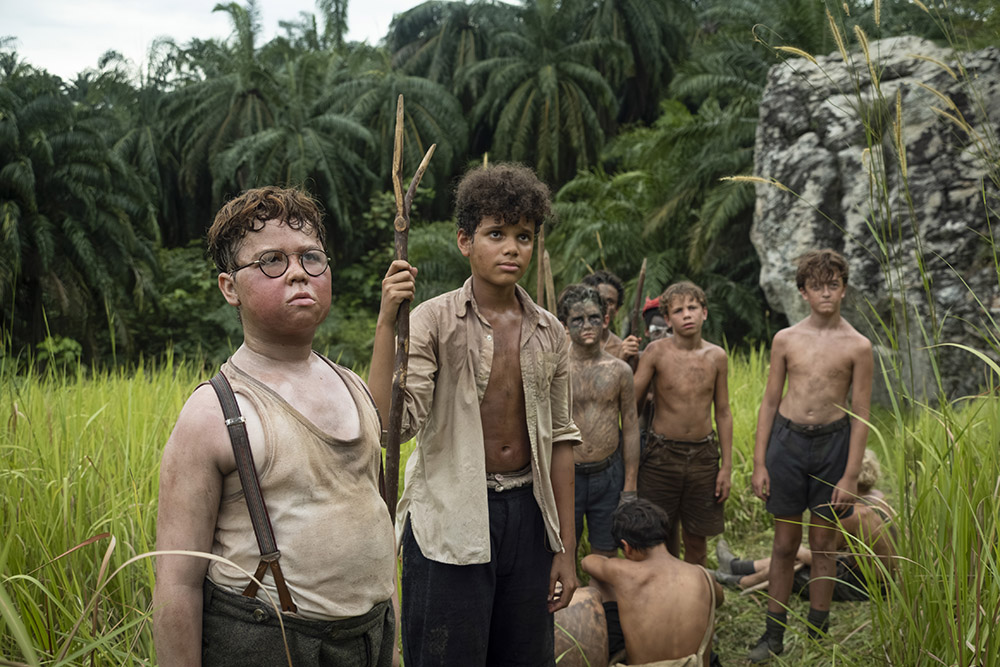
The first television adaptation of William Golding’s “Lord of the Flies” landed on Netflix May 4—and for students who spent a semester dissecting the novel in sophomore English, this four-part series arrives with a lot to prove.
The adaptation, written and directed by Jack Thorne and originally aired on BBC in the United Kingdom, takes a structural approach no film version has attempted: each of the four hour-long episodes centers on a different character—Piggy, Jack, Simon and Ralph—told entirely from that character’s point of view. Thorne, best known for the award-winning series “Adolescence,” began with Piggy and ends with Ralph.
The premise of Golding’s 1953 novel remains intact. A group of young English schoolboys crash onto a remote island during wartime, and without any adults to impose order, they are left to build their own society from nothing. What begins as desperate survival fractures quickly into something darker, as the power struggle between Ralph’s elected leadership and Jack’s tribal rebellion strips away whatever civilization the boys carried onto the island with them.
Golding’s novel was never subtle about its argument: that the impulse toward violence and cruelty is not an aberration but a feature of human nature, even in children. That argument is landing differently in 2025 than it did in 1953—or even in the years the novel has spent on high school reading lists.
Mr. Paul Krogmeier, who teaches Literature of the Silverscreen and the novel in his English 2 classes, said the story speaks directly to tensions playing out in contemporary culture. He pointed to the rise of what he called the “manosphere”—online communities centered on a particular vision of masculinity—and the broader political moment around it.
“On the surface, people could see it as speaking to this moment,” Krogmeier said. “But maybe that’s a good thing, because once they sit down and watch it, maybe they realize that there’s actually [an] alter[nate] motive in the way that he wrote the story.”
Krogmeier noted that Golding deliberately constructed an all-male, homogeneous cast not to celebrate that setup but to strip away every variable except human psychology.
The irony, he said, is that a story some might read as validation of old-school masculine tribalism is actually a warning against it—Jack is the book’s anti-hero, not its hero, and he is not redeemed at the end.
Jaidyn Ormsbee, a senior whose favorite book is “Lord of the Flies,” hasn’t yet watched the adaptation but said he plans to. He said the novel’s relevance has only grown.
“The book itself gets more relevant as time has moved on,” Ormsbee said. “It’s just as relevant today as it was when it was published.”
Ormsbee said he sees the novel’s themes of group psychology and lost innocence playing out in real time—particularly through social media’s effect on younger male audiences.
Boys who feel unseen or unheard, he said, are increasingly drawn to online communities that offer belonging, sometimes at a cost.
“They get convinced to do things because they feel like they’re not seen or heard properly,” Ormsbee said, “and so they join the masses where they feel they’re seen or heard, and that can often have a detrimental effect on their mental health and their lives.”
The series format, both said, gives Thorne tools that film couldn’t.
Krogmeier said the novel’s third-person narration has always kept readers at arm’s length from its characters’ inner lives.
“You would get inside of their motivations a lot more,” Krogmeier said of the episodic structure. “You get to see a lot more why they make the decisions that they do.”
Ormsbee made a similar case.
The story has already been adapted twice on film, he said, and another straightforward retelling would have little to add.
“By changing it so that you have one episode looking at each of the characters, it really can deep dive into each individual character’s psyche,” Ormsbee said, “and really get into their head and what they were thinking and what really happened to them.”
Krogmeier said starting with Piggy—rather than Ralph, who opens the novel—is a smart structural choice.
“He’s such an outsider, and he’s the smart one, so he can see the problems of everything,” Krogmeier said of Piggy. “It really lays the foundation of the problems. It lays some good foreshadowing.”
Where the episodic format may cost Thorne something, Krogmeier said, is in the cumulative weight of the novel’s central arc.
“That whole narrative arc of the slow loss of civilization and the slow loss of structure would be much more evident” in a film, Krogmeier said, “because you would see it all as one unit, rather than chunked out.”
The cast is largely made up of newcomers making their acting debuts. Winston Sawyers plays Ralph, Lox Pratt plays Jack, David McKenna plays Piggy and Ike Talbut plays Simon. An open casting call allowed actors to audition without prior experience, prioritizing raw ability over résumé—a decision that, for better or worse, puts the weight of Golding’s most morally demanding characters on shoulders that have never carried them before.
One casting choice has drawn particular attention: Sawyers, who plays Ralph, is not white—a departure from both previous film adaptations and the novel’s implied casting. Krogmeier said that choice complicates the story in ways worth watching closely.
“As they turn on him, maybe it takes on a sinister meaning of sorts,” Krogmeier said. “I would be interested to see” whether the series addresses that dynamic directly “or if they just kind of pretend like it’s not there.”
Principal filming took place in Malaysia over roughly three to four months. The production team worked through intense humidity, tropical storms
and wildlife to capture an environment that actually feels dangerous—something the 1990 adaptation, shot in Jamaica, failed to convincingly achieve. Additional scenes filmed in London will reportedly establish backstories for Ralph and Jack that Golding never provided.
What is clear is that Thorne is not interested in a straightforward retelling.
For Community students who read the novel this past year, that should make “Lord of the Flies” worth watching—not as a companion to the text, but as an argument with it.