


















![Coach’s Corner: Konopasek on Iron volleyball’s 34-6 run, what’s next [video]](https://nchsinkspot.com/wp-content/uploads/2025/11/Vball-season-recap.00_00_02_22.Still005.png)


![Postgame: Volleyball falls to Marist in supersectional [video]](https://nchsinkspot.com/wp-content/uploads/2025/11/Vball-postgame.png)



![Halloween candy cross section quiz [quiz]](https://nchsinkspot.com/wp-content/uploads/2022/10/Candy-cover-big-900x675.png)
![Average Jonah? [quiz]](https://nchsinkspot.com/wp-content/uploads/2022/05/average-jonah-900x600.png)




![[Photo Illustration]](https://nchsinkspot.com/wp-content/uploads/2025/09/trigger-words-1.png)


![On the Spot: Students, staff share their takes on groundbreaking music [video]](https://nchsinkspot.com/wp-content/uploads/2026/02/Untitled-7-1.png)

![The Up-Beat – Snow, stage sets and an Illinois upset [video]](https://nchsinkspot.com/wp-content/uploads/2026/01/Untitled-10.png)
![Coaches’ Corner: Witzig, Feeney break down team identity, key growth, the road to March [video]](https://nchsinkspot.com/wp-content/uploads/2026/01/Coaches-Corner-Jan-21-1200x675.jpg)
![On the spot: Community’s favorite movies [video]](https://nchsinkspot.com/wp-content/uploads/2026/01/On-the-Spot-7.png)



![On the Spot: Staff, students sound off on the Chicago Bears’ playoff run [video]](https://nchsinkspot.com/wp-content/uploads/2026/01/On-the-Spot-4.png)
![Hauntcert performers on why this year’s show hits all the right notes [video]](https://nchsinkspot.com/wp-content/uploads/2025/10/Untitled-2.png)

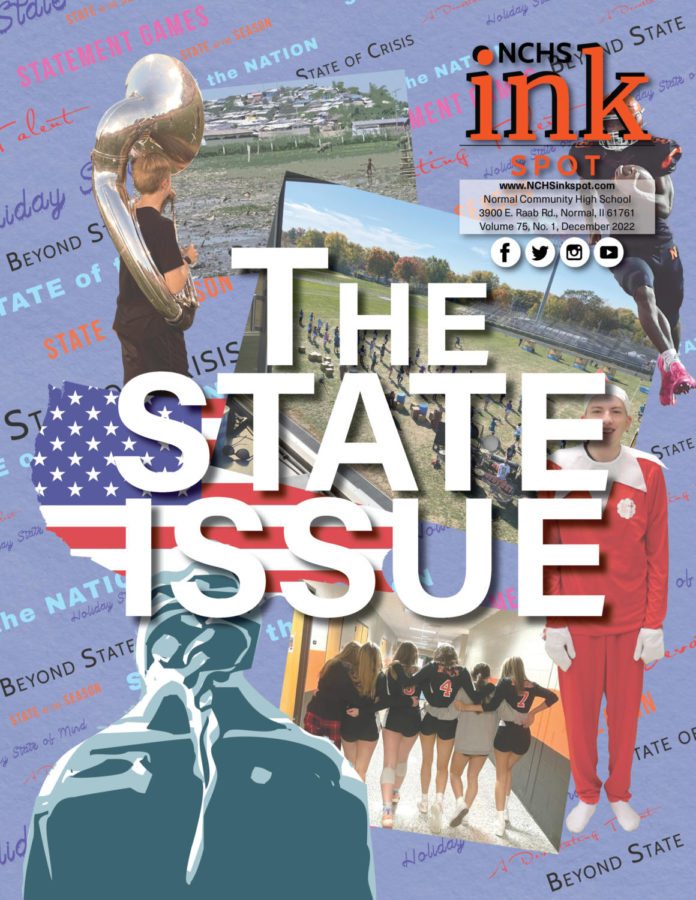




That Downers Grove North game in 2024 at Redbird Arena felt different.
The gym was alive. The noise was not occasional bursts but a constant roar that stayed the whole game. Every possession felt massive. Every bucket felt like a 10-point swing.
That is what a strong student section can do.
It changes a game in ways that go beyond cheering. Players feed off the energy, and the crowd settles into a rhythm that carries the entire building.
A regular night becomes an experience people remember.
“A good student section can have a huge impact on how a game flows,” Athletic Director Mr. Nic Kearfott said. “A positive, loud, energetic section changes the atmosphere for everyone.”
Positive is a word Kearfott returned to often. Student section size matters, he said, but a positive presence matters more. A group that is engaged and connected can shift the tone of a gym immediately.
Community has seen that togetherness before.
Kearfott pointed to playoff football games against Bradley-Bourbonnais in 2023 and Pekin in 2022 and regular season contests against the Normal West Wildcats, along with the atmosphere during 2o24’s Quincy basketball game.
He called the boys basketball super-sectional against Downers Grove at Redbird Arena the loudest crowd he has witnessed as an athletic director.
“Our student section was enormous,” Kearfott said. “It was loud and electric, and it had an effect on the result of the game.”
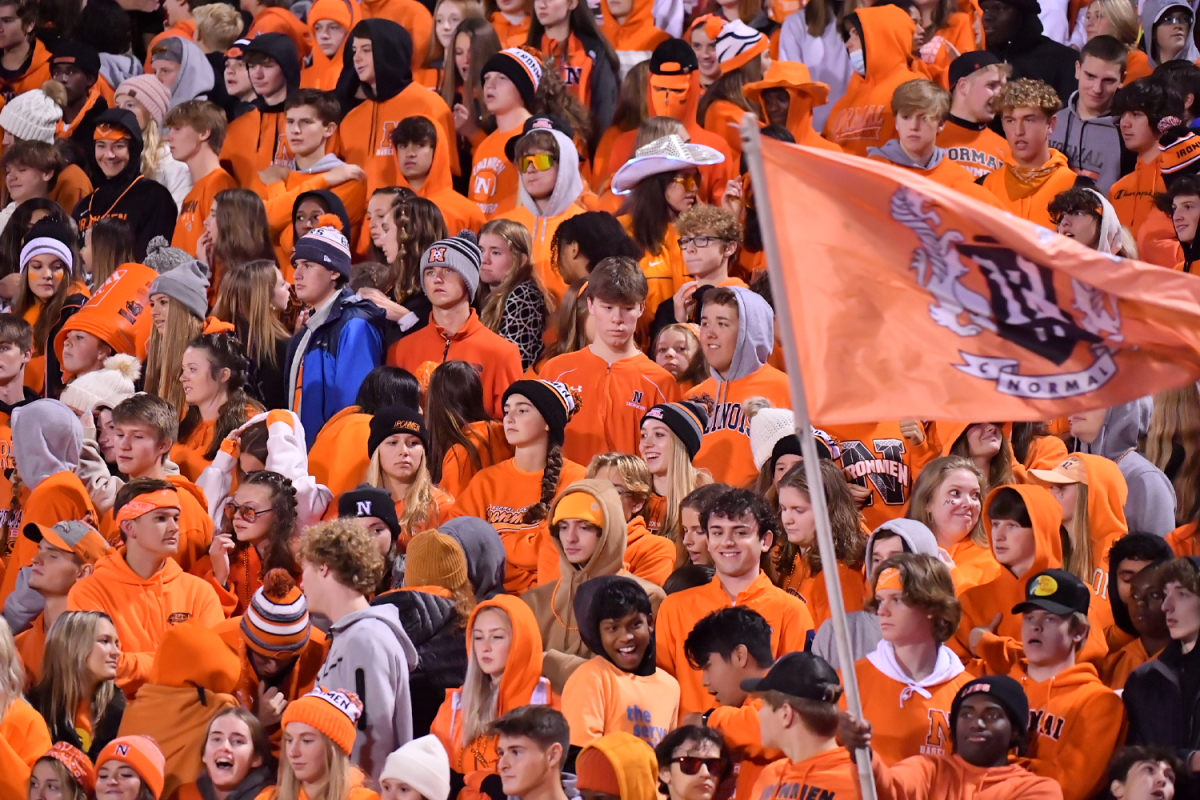
Mr. Jason Drengwitz, Ironmen head football coach, sees the same effect on Friday nights. The student section, he said, becomes part of the event itself.
“When there’s a good student section, there’s good school spirit,” Drengwitz said.
That connection shows up across the building. A strong student section pulls musicians, performers and athletes into the same room—students who otherwise move through entirely separate routines. It is one of the few spaces where a school of more than 2,000 students is visibly connected.
That kind of atmosphere, though, does not happen automatically. And right now, it is not happening consistently enough.
Kearfott said attendance at some football, basketball and volleyball games this year “was not the norm or what it has been.” Drengwitz said he wants to see more consistent turnout for winter and spring sports, especially given how the teams have performed.
“I wish it would be bigger,” Drengwitz said. “Especially when the teams are having the success they’re having.”
That gap between success on the field and silence in the stands should bother people.
Schedules play a role. Football games sit on Friday nights, free from the weeknight pull of work, homework and practice. Other sports have to fight for the same crowd on a Tuesday or Wednesday.
“It’s not as automatic anymore that kids go to sporting events,” Drengwitz said.
But scheduling is an explanation, not an excuse. The students who showed up at Redbird Arena had the same homework loads and the same practice schedules as everyone who stayed home. They chose to be there.
Even with the conflicts, both Kearfott and Drengwitz pointed to leadership as the difference-maker. Kearfott said the program needs students willing to set the tone—whether through Iron Invasion or on their own.
“We need to find some strong leaders,” Kearfott said. “Whether they’re part of Iron Invasion or just student leaders that can draw kids to games.”
He also said students need to gather rather than scatter across the stands.
“We’re more powerful and more impactful if we’re together as one,” Kearfott said.
That ownership has always shaped the strongest crowds. It gives younger students something to step into and continue as they move through the building.
Support across activities matters, too. Drengwitz, who grew up going to band concerts and madrigals because his father insisted on it, said the same logic applies to athletes.
“If you want people to come out and support you, you need to go out and support other people,” Drengwitz said.
Building that environment involves more than the student body alone. Kearfott said the athletic department has explored attendance incentives and is looking at tools through the Ironmen app that could encourage students to show up across athletics, fine arts and clubs.
“Kids love incentives,” Kearfott said. “We’re looking at options there.”
Incentives can help. But the strongest environments do not start with giveaways. They come from a genuine decision to show up together and for each other.
Nights like the Quincy game, the football crowds against Bradley-Bourbonnais and Pekin, and the super-sectional basketball game at Redbird Arena stand out because students made that choice. Nobody offered a T-shirt. Nobody had to. The event was the reward.
A student section is far more than noise. It shapes how games are remembered. It gives teams energy they can feel. It gives a school something to rally around.
Community has shown what that looks like. Now the question is whether students are willing to make it the standard—not just for the biggest games, but for the
Tuesday night volleyball match, the Wednesday soccer game and the Thursday swim meet that deserve the same energy.
The choice belongs to the student body. It always has.