



















![Coach’s Corner: Konopasek on Iron volleyball’s 34-6 run, what’s next [video]](https://nchsinkspot.com/wp-content/uploads/2025/11/Vball-season-recap.00_00_02_22.Still005.png)


![Postgame: Volleyball falls to Marist in supersectional [video]](https://nchsinkspot.com/wp-content/uploads/2025/11/Vball-postgame.png)



![Halloween candy cross section quiz [quiz]](https://nchsinkspot.com/wp-content/uploads/2022/10/Candy-cover-big-900x675.png)
![Average Jonah? [quiz]](https://nchsinkspot.com/wp-content/uploads/2022/05/average-jonah-900x600.png)




![[Photo Illustration]](https://nchsinkspot.com/wp-content/uploads/2025/09/trigger-words-1.png)


![On the Spot: Students, staff share their takes on groundbreaking music [video]](https://nchsinkspot.com/wp-content/uploads/2026/02/Untitled-7-1.png)

![The Up-Beat – Snow, stage sets and an Illinois upset [video]](https://nchsinkspot.com/wp-content/uploads/2026/01/Untitled-10.png)
![Coaches’ Corner: Witzig, Feeney break down team identity, key growth, the road to March [video]](https://nchsinkspot.com/wp-content/uploads/2026/01/Coaches-Corner-Jan-21-1200x675.jpg)
![On the spot: Community’s favorite movies [video]](https://nchsinkspot.com/wp-content/uploads/2026/01/On-the-Spot-7.png)



![On the Spot: Staff, students sound off on the Chicago Bears’ playoff run [video]](https://nchsinkspot.com/wp-content/uploads/2026/01/On-the-Spot-4.png)
![Hauntcert performers on why this year’s show hits all the right notes [video]](https://nchsinkspot.com/wp-content/uploads/2025/10/Untitled-2.png)






Unit 5 has launched an enrollment study to address growing discrepancies in school enrollment, evaluate how schools are used and create more equitable attendance boundaries across the district.
In September the Unit 5 school board approved hiring Cropper GIS, a consulting firm that specializes in demographic analysis and K-12 enrollment forecasting, to conduct the study.
Consultant Matt Cropper will work with an internal planning committee made up of district-level leadership, school board members and building administrators, including Community principal Dr. Adam Zbrozek and other school leaders, to analyze enrollment trends and develop options for new attendance boundaries.
The benefit of having a diverse group, Superintendent Dr. Kristen Weikle said, is that building administrators can provide insight about “their individual buildings” while board members bring a “global view” and “think about things for the entire district.”
The study will compile data on Unit 5 students, including lunch eligibility, race, proximity to school and other relevant factors, and examine how to use space more effectively across the district.
Focuses and challenges
A primary focus when determining new boundaries will be how different student groups are distributed among schools, while also taking into account building size and square footage—a current concern with eight portable classrooms spread across the district, including two at Community.
Weikle said that focusing only on equal distribution, without considering building size, could create new problems because “obviously we can’t pack full a small building with lots of kids.”
Another challenge, Weikle said, are housing patterns tied to income.
When looking at indicators such as free and reduced lunch eligibility, she said the town of Normal and city of Bloomington often locate more affordable housing developments “in similar spots” rather than spreading them across the community, which can create challenges for balancing diverse student populations.
“It’s not to say that schools will have an equal percentage of students in different groups,” Weikle said, but it is among several important factors Unit 5 “wants to keep it in mind.”
Goals of the study
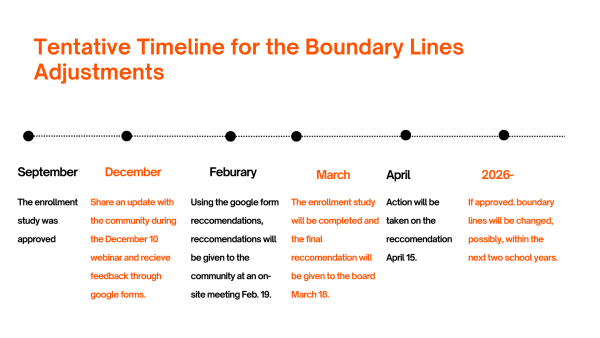
The enrollment study, which is expected to be completed by March 2026, will cost the district $112,000. The goal, Weikle said, is not financial gain but long-term benefits for students.
Currently, the enrollment gap between Community and West is almost 500 students, with Community at 1,973 students and West at 1,498. Redrawing boundaries could help minimize overcrowding at Community and reduce the district’s reliance on portable classrooms.
Weikle said the district hopes to balance enrollment and decrease the use of portables, especially at the elementary level.
“We don’t want any students to have to receive instruction in portables,” she said, “but particularly younger kids when they’re needing to go from a portable into the school to use the restroom.”
Weikle said enrollment changes also shape how people view Unit 5 schools. When community members ask why certain neighborhoods are assigned to one school instead of another, she said shifting a neighborhood could significantly change that school’s demographics. In other communities without a balance of student populations, she said, one school can develop a “different reputation” than another.
Weikle said district leaders believe “both of our high schools are great” and want to avoid “misperceptions based solely on a number.”
Other goals for new boundaries include balancing enrollment while planning for higher growth areas, keeping boundaries continuous, drawing clear boundary lines and sending students to the nearest appropriate school when possible.
Why now
There is “no requirement to redistrict ever,” Weikle said, but district leaders “felt like we needed to update the enrollment study and consider boundary changes.”
Discussions about boundary changes are not new in Unit 5, Weikle said.
“This is my sixth year in Unit Five, and I feel like since I came, which was during COVID, there’s always been a little bit of talk about certain schools,” Weikle said.
Weikle said some schools are “underutilized,” with “low enrollment,” while others are “so full,” creating “that imbalance.” She said perceptions about differences between schools are sometimes grounded in “fact” and other times in “people’s opinion.”
The district last significantly updated boundaries more than a decade ago, when George Evans Junior High was built, Weikle said.
How changes could be implemented
To Unit 5, the current imbalance is real, but Weikle said the district is not planning sweeping changes.
Despite community fears that boundary changes could “upend things,” she said the district is not “talking about anything massive.”
Plans for new boundary lines, which will most likely be implemented within the next two school years, will focus on “natural adjustments that would make the most sense,” Weikle said.
“So it may be just making adjustments, it may be doing additions, it may be a combination of things,” she said.
For now, the internal planning committee is “answering questions,” Weikle said, and “giving advice to Cropper GIS” ahead of a December 10 webinar.
How the community can get involved
The public is invited to attend a virtual meeting at 6 p.m. Wednesday, Dec. 10, to learn more about the enrollment planning study.
The one-hour webinar will be facilitated by Cropper GIS and will provide an update on the first phase of planning, which focuses on identifying facility needs and how schools are used across Unit 5.
The presentation will review facility considerations explored so far and explain how the community can stay informed throughout the process, with time be reserved for questions at the end.
During the webinar, the district will introduce an online survey that will allow the public to share feedback on those considerations.
That feedback, Weikle said, will help shape the boundary recommendations the district plans to share with the community at that February session.
Attendance boundary options will not be presented at the December webinar. Those options are scheduled to be shared during a Public Information Session on Feb. 19, 2026, as part of the second phase of planning.
A link to attend the virtual meeting is available here.
The district will continue to post updates about the enrollment planning study at www.unit5.org in the coming weeks.
For more information, visit unit5.org/about-u5/boundaries-maps or unit5enrollmentplanning.com