
















![Coach’s Corner: Konopasek on Iron volleyball’s 34-6 run, what’s next [video]](https://nchsinkspot.com/wp-content/uploads/2025/11/Vball-season-recap.00_00_02_22.Still005.png)


![Postgame: Volleyball falls to Marist in supersectional [video]](https://nchsinkspot.com/wp-content/uploads/2025/11/Vball-postgame.png)



![Halloween candy cross section quiz [quiz]](https://nchsinkspot.com/wp-content/uploads/2022/10/Candy-cover-big-900x675.png)
![Average Jonah? [quiz]](https://nchsinkspot.com/wp-content/uploads/2022/05/average-jonah-900x600.png)




![[Photo Illustration]](https://nchsinkspot.com/wp-content/uploads/2025/09/trigger-words-1.png)


![On the Spot: Students, staff share their takes on groundbreaking music [video]](https://nchsinkspot.com/wp-content/uploads/2026/02/Untitled-7-1.png)

![The Up-Beat – Snow, stage sets and an Illinois upset [video]](https://nchsinkspot.com/wp-content/uploads/2026/01/Untitled-10.png)
![Coaches’ Corner: Witzig, Feeney break down team identity, key growth, the road to March [video]](https://nchsinkspot.com/wp-content/uploads/2026/01/Coaches-Corner-Jan-21-1200x675.jpg)
![On the spot: Community’s favorite movies [video]](https://nchsinkspot.com/wp-content/uploads/2026/01/On-the-Spot-7.png)



![On the Spot: Staff, students sound off on the Chicago Bears’ playoff run [video]](https://nchsinkspot.com/wp-content/uploads/2026/01/On-the-Spot-4.png)
![Hauntcert performers on why this year’s show hits all the right notes [video]](https://nchsinkspot.com/wp-content/uploads/2025/10/Untitled-2.png)


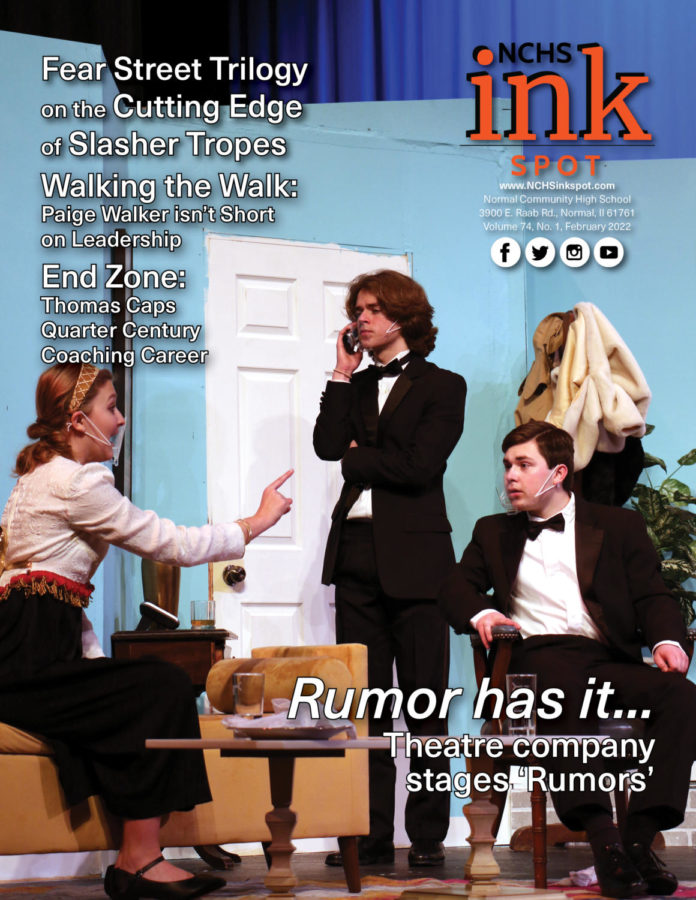



When William Shakespeare died, his plays did not arrive at immortality neatly bound and shelved. In Lauren Gunderson’s “The Book of Will,” they teeter on the edge of disappearance—pages scattered, lines misremembered, stories at the mercy of whoever gets to them first.
That is the tightrope Community’s Theatre Department walks in its winter production: a “mostly true” story with a deadline baked into every scene. Directed by theater teacher Ms. Cassie Adelman, “The Book of Will” runs Feb. 12-15 in the Ms. Kevin Yale Vernon Auditorium.
The race to keep Shakespeare from being scattered
Adelman describes the play with a warning: it is about Shakespeare, but Shakespeare “is nowhere to be found.”
“The play takes place about three years after his death,” Adelman said, as members of his theatre company, the King’s Men, begin to realize if they do not preserve the plays, “they will be lost to time.”
The show follows the scramble to collect, edit and print a lifetime of work into what audiences now know as the First Folio. It is a story about paper and ink, but it plays like a story about memory—who gets kept, who gets rewritten, who gets forgotten.
“It is comedic but heartfelt look,” Adelman said, about humanity, the art we create, and how “both are remembered throughout time.”
The hook is historical. The punch is personal. The characters are not debating whether Shakespeare mattered. They are debating whether his work will physically survive long enough for anyone to decide.
“Publish or vanish,” and a cast staring at its own clock
In rehearsal, Adelman said she stopped to look at her cast list and felt the theme snap into focus.
“I actually went back and double checked, and most of [the cast] are seniors,” she said.
That detail gives the production a second narrative line running beneath the First Folio plot: the cast itself is nearing a final curtain on high school theatre. Adelman said the play’s early emphasis on “publish or vanish” pushed her to frame rehearsals with urgency—not as pressure for pressure’s sake, but as a reminder that time moves whether you are ready or not.
“There’s a whole point at the beginning of the show,” Adelman said: “Do this for the people who have gone.”
The director described a moment early in the show when characters trade memories about friends who are no longer there, then keep working anyway. She connected that rhythm—remembering, then moving—to the way seniors leave behind traditions and inside jokes that younger actors inherit.
Adelman challenged the ensemble to remember their first production and the upperclassmen in the cast: “Remember your seniors, remember the fact that those memories are gone and you have to preserve them,” she said, “but also you don’t have much time left.”
For Adelman, that became the emotional spine: a cast full of students in large roles performing a story about people racing to keep something alive.
“It’s kind of existential,” she said. “Time is ticking for how much time you have left here, so make it count.”
Two leads carrying the story—and rarely leaving the stage
The play’s urgency lands on the shoulders of two characters who do most of the carrying: Henry Condell and John Heminges, Shakespeare’s surviving friends and fellow actors. At Community, those roles are played by seniors Miguel Patiño-Diaz as Condell and Cohen Boyd as Heminges.
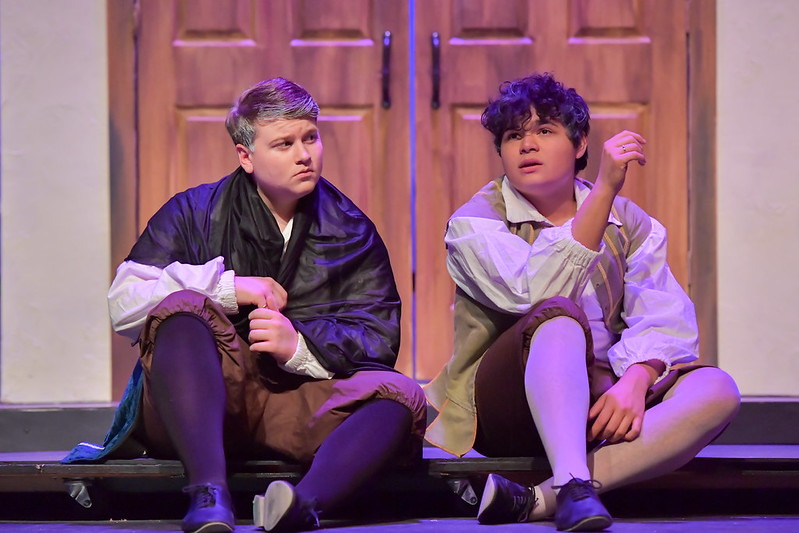
The duo’s partnership, Adelman said, matches the show’s pulse: one is the logic, one is the feeling.
“The best way I can describe it is that Cohen’s character is the brains of the operation, and Miguel’s character is the heart of it,” she said.
Adelman said the two have enough offstage familiarity to argue onstage without losing the trust underneath it—the kind of friendship an audience can recognize even when it’s loud.
“They can argue with each other and get in each other’s faces,” she said, “but you can still believe that they are best of friends.”
Adelman also credited the veteran actors on their professional instincts: making choices, correcting choices and adjusting in real time.
“I would be about to give a note about that, but they would fix it within themselves,” Adelman said. “They are very experienced actors for high schoolers.”
In “The Book of Will,” Condell and Heminges are constantly in motion, shifting between grief, banter and the blunt mechanics of publishing.
Adelman said her leads are in nearly every scene—a workload that mirrors the play’s central point: legacy is not an idea. It is labor.
An ensemble that builds the comedy, then builds more
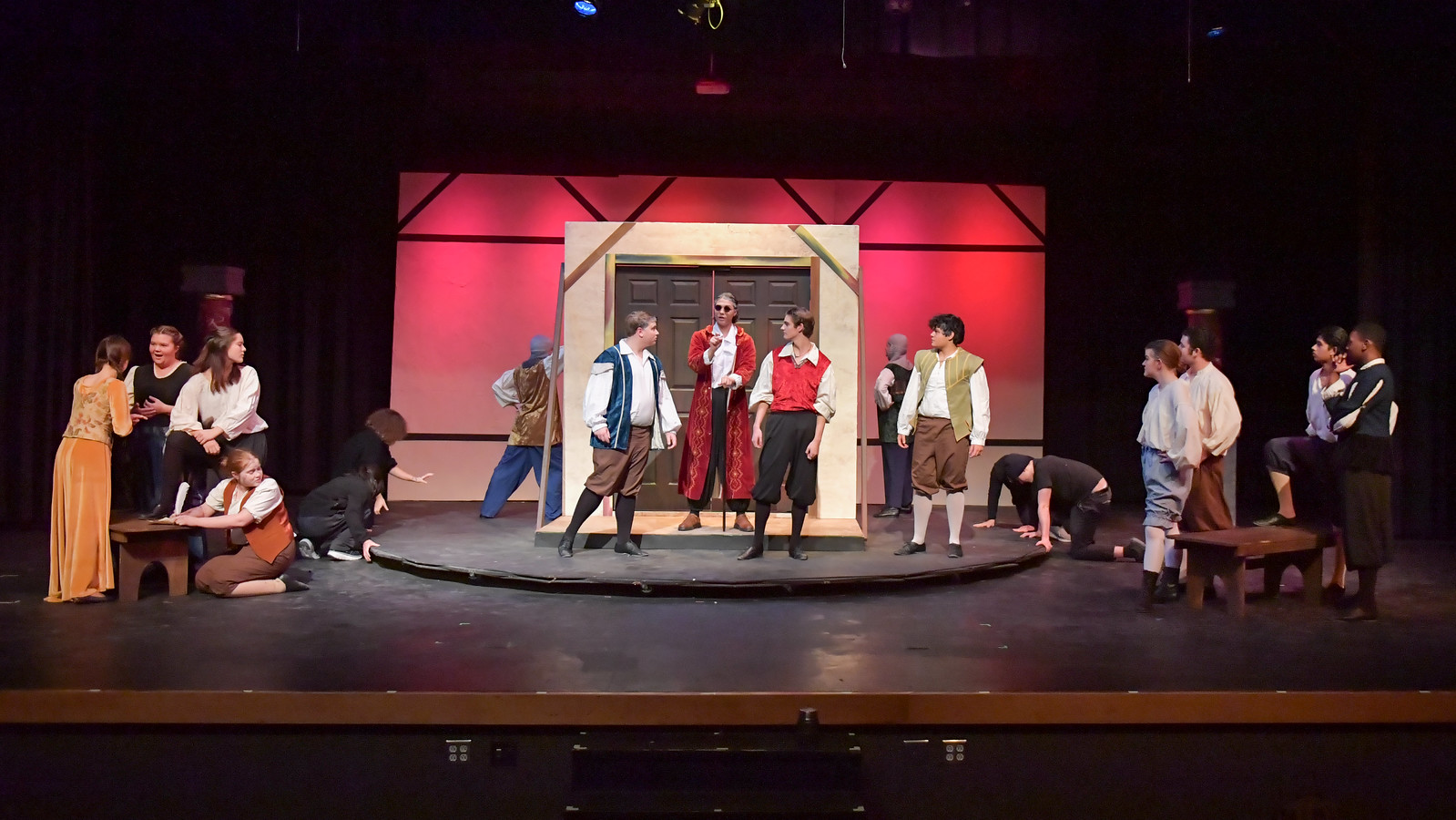
Audiences, Adelman said, should not expect a solemn museum piece.
“First and foremost, it is a comedy.”
That comedy is not just in the script. It is something students helped shape, the director said.
Some actors “begged and pleaded” to add jokes, and she let them.
The result, she said, is an ensemble that does not wait to be told how to be funny. She described performers creating bits beyond what she initially assigned, then stacking those choices into scenes that feel alive rather than ”set.”
“I gave them something to do,” she said, ”and they created whole other bits that are just fun to watch.”
One example comes early: a scene from “Hamlet” plays while other action continues, meaning the actors performing “Hamlet” must be engaging without hijacking the story. Adelman said she challenged the cast to find that balance.
“I need it to still feel fun to watch without taking away from what’s going on,” she said. “They made it genuinely part of the scene and fun to watch without pulling away from everything else.”
Gender bending and “vibes” over tradition
Shakespeare’s era is often taught with a footnote: women could not perform onstage. “The Book of Will,” however, is full of women, and Adelman said the production leans into casting flexibility rather than treating history as a restriction.
“The first character we see on stage is named Boy Hamlet,” Adelman said,“a role played by a girl,” sophomore Laila Aprahamian.
The director said she was willing to gender-bend roles if actors requested it, and that her approach centered on what fit each character, not on matching a gender expectation.
“I mostly just went for vibes with the characters,” she said.
Vibes that led to Natalie Perkins casting as Richard Burbage, the King’s Men’s leading actor and another driving force in the push to preserve Shakespeare’s plays.
That choice fits a play that already questions how “authentic” any version of Shakespeare can be. In a story about texts being copied, rearranged and corrected, the production’s casting carries the same idea: what matters is the truth of the performance, not the rigidity of a rulebook.
The turntable that doesn’t “need” to be there—and that’s the point
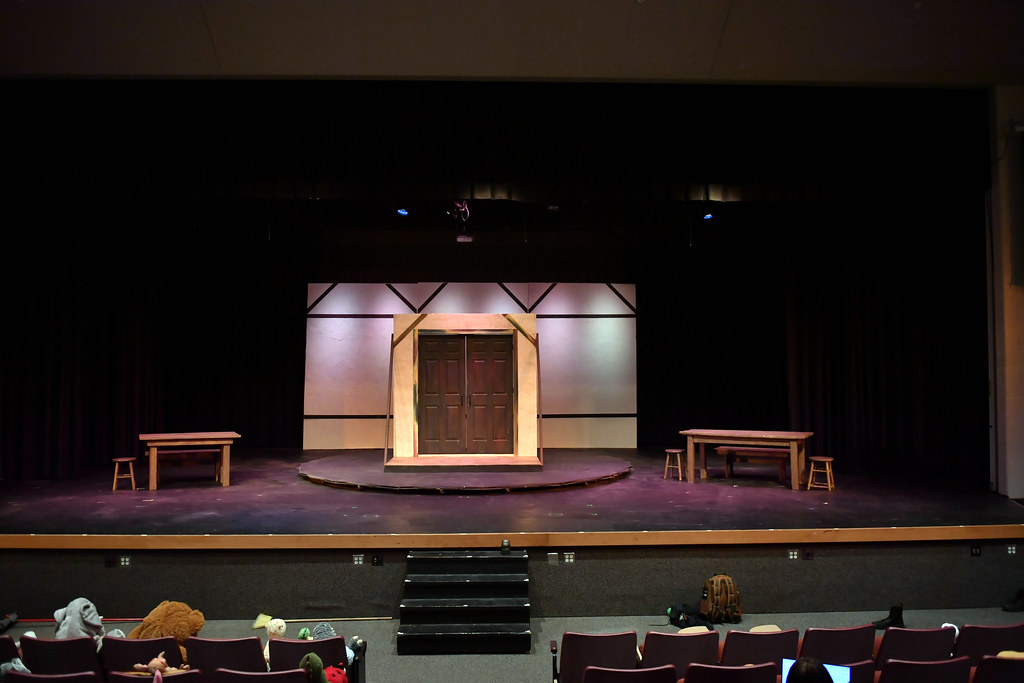
Some elements of the production exist because they help tell the story. Others exist because theatre kids saw an opportunity and could not resist it.
The use of a turntable in the production is both.
“Does this play really need a turntable?” Adelman said. “Probably not.”
But the department found one in the shop, realized it could work and decided to build it into the show’s language. Adelman said it is used in nearly every transition, giving the production momentum and a signature visual rhythm.
“It’s been one of those things that … gets used probably in every single transition,” she said. “It’s just made that extra oomph of, not only is it a show, but it’s a show with a turntable.”
Adelman said students latched onto it immediately—not just as a technical tool, but as a toy, a bragging right and a shared joke.
“It’s something that the kids go nuts for,” she said. “I get to push a turntable on stage.”
She described cast members filming TikToks with it, racing around it, testing moonwalks—small, goofy moments that sit beside the play’s big theme. In a show about preserving art, the turntable became a reminder of how art gets made: through risk, play and a group of people willing to try something simply because it might be cool.
A story about who does the saving
Onstage, “The Book of Will” is about friends collecting pages before they disappear. At Community, it is also about a group of seniors and underclassmen building something that will vanish the moment the lights go down—unless the audience carries it out with them.
That is the quiet echo between the play’s world and the auditorium’s: scripts are fragile. Seasons end. People graduate.
What lasts is what someone chooses to preserve.
And, as Adelman put it, the decision comes faster than anyone expects.
What: “The Book of Will,” by Lauren Gunderson
When: Feb. 12-15 (7 p.m. performances, 2 p.m. Saturday matinee)
Where: Ms. Kevin Yale Vernon Auditorium
Tickets: $10 adults, $5 students (plus $1 fee online); available at the door or online
Other details: Doors open 30 minutes before show time; 15-minute intermission
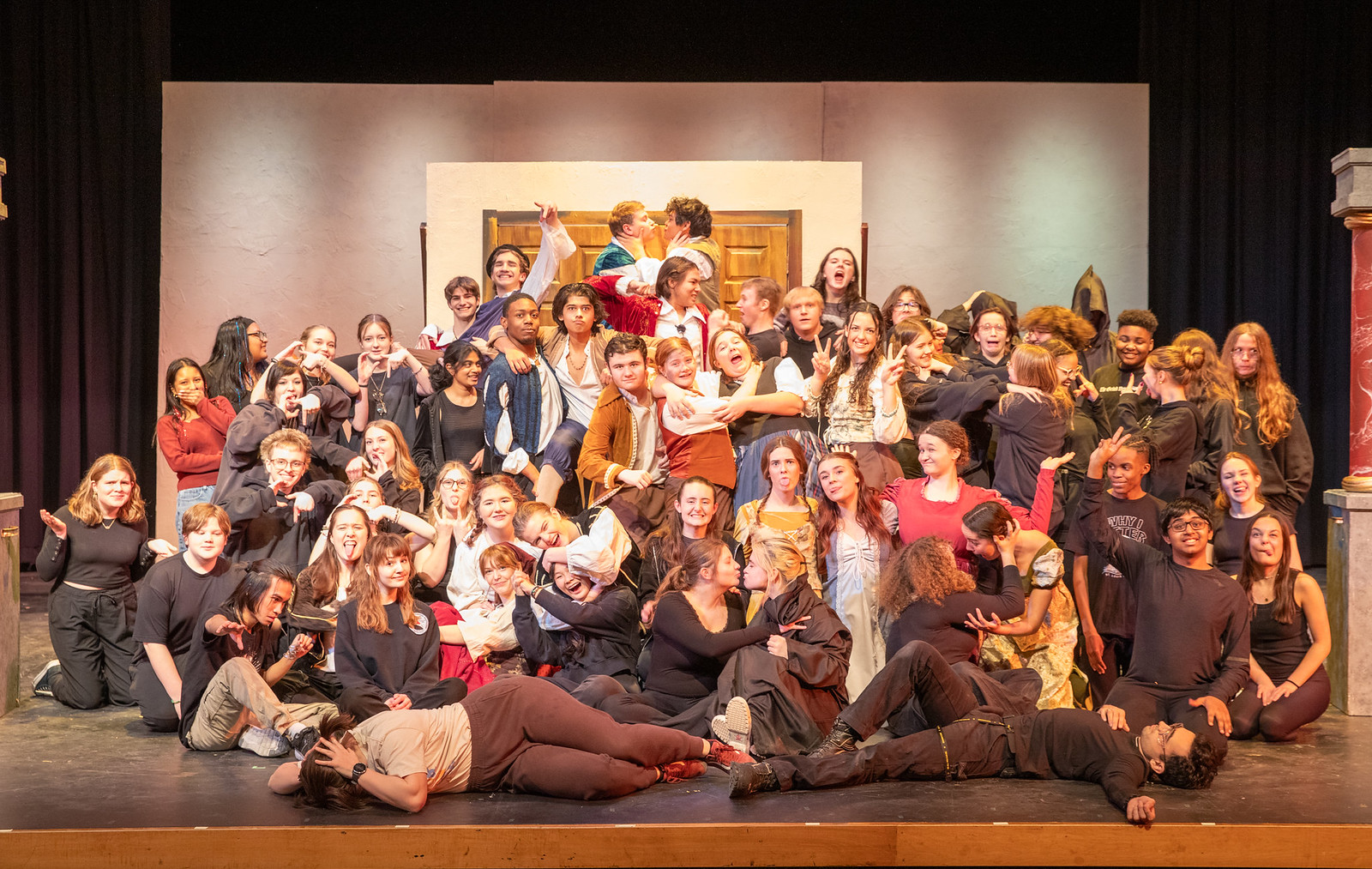
Who: The cast includes Natalie Perkins as Richard Burbage, Josie Hinch as Alice Heminges and Laila Aprahamian as Boy Hamlet.
Other roles include Ella Drake as Elizabeth Condell, Ireland Higgins as Rebecca Heminges, Vedant Thakur as Ben Jonson, Richard Hagan as Ed Knight, Lauren Graham as Ralph Crane, Matthew Hara as William Jaggard, Ryan Robinson as Isaac Jaggard, Hannah Dorr as Marcus, Emery Jennings as the Compositor, Lacy Hefter as Emilia Bassano Lanier, Katy Berna as Anne Hathaway Shakespeare, Lindi Rardin as Susannah Shakespeare and Maren Jimison and Coelton Harris as Criers.
The production team also includes assistant director Em Irey and technical director Raymond Zaloudek.